

What eggcorns taught me about social change in 2025
Recently, I was proofreading my forthcoming book. I learned when proofreading, I have to read every word out loud…it’s the only way to really hear where a sentence has an awkward bit or something doesn’t quite land.
Partway through, I came across a section that used the phrase “you can home in on what matters most to you.”
I stopped.
It seemed wrong. “Isn’t the phrase to hone in?” I wondered aloud to myself.
A quick check told me otherwise: the correct phrase is actually “home in” — as in “to home in on something.” Hone in is a very common mix-up.
That’s how I learned the term eggcorn: a word or phrase that sounds right, but isn’t. The name eggcorn itself comes from a mishearing of acorn.
And here’s why this stuck with me:
It mirrors something I’ve been writing about in the book.
Right now, so many of us are experiencing what I call the trifecta of change – three conditions that make it feel harder than ever to drive change:
The big, complex problems we’re facing
Falling trust in traditional institutions
The radical pace at which everything is shifting
Put together, they create a kind of “mishearing.” It’s easy to look at the moment we’re in and assume everything is stuck or getting worse. And it makes sense that it seems that way. The evidence is strong and the feeling is palpable.
But when you look again, there’s another interpretation available:
These same conditions are also opening unprecedented opportunities for individuals and communities to drive impact.
Just like an eggcorn, one version seems feasible, but the other one is more accurate.
Before we go deeper, here are a few eggcorns you might recognize:
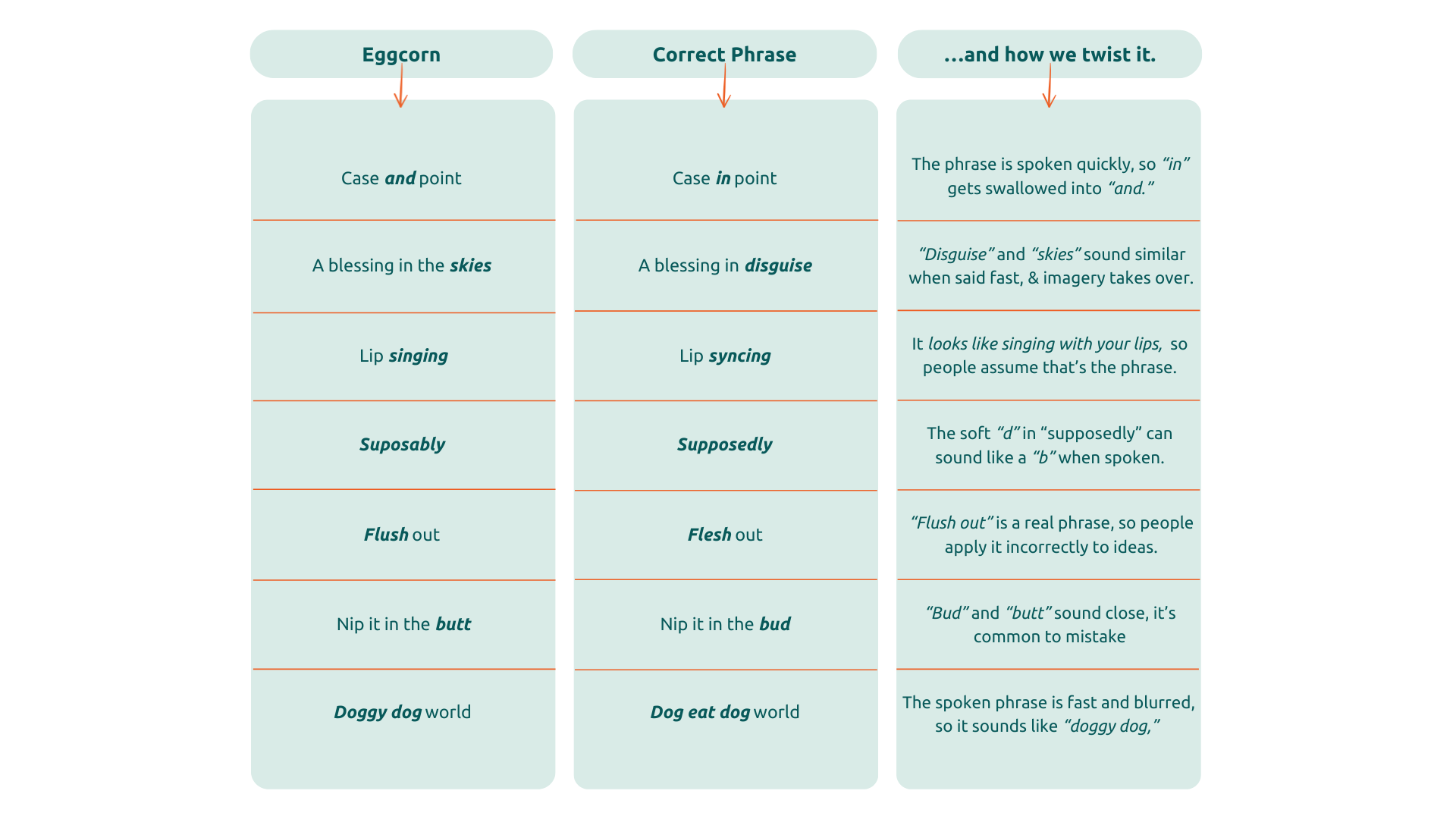
Looking at that list made me realise that it is easy to default to a story if we hear it over and over again – even if it’s not accurate. While it’s easy to believe that everything is headed in the wrong direction, 2025 offered plenty of moments that challenged that narrative and showed that incredible change is occurring in communities, even when it doesn’t get the attention it deserves.
Here are a few examples from this year that stood out to me:
A groundbreaking gene therapy has driven remission in patients with previously untreatable blood cancers. Nine patients at Great Ormond Street and King’s College Hospital in the UK received the treatment, which reprograms white blood cells into a “living drug”. Seven remain cancer-free three years later. Read More at Positive News.
Renewable energy produced more electricity than coal for the first time on record. This is in part driven by record growth in solar in 2025. Read More in this report from global think tank Ember.
South Sudan’s national blind football team made history by winning the African Championship Division 2. Just five years after blind football was introduced in South Sudan, this is a major milestone for disability access and inclusion in the country and around the world. The team will now play in Division 1 and the victory puts them on a path toward potential qualification for the 2028 Paralympic Games in Los Angeles. Read More at Light for the World.
And there are countless more when you look for them.
As I looked back at this year, a clear pattern stood out: even in a moment that feels heavy, there are signs of progress worth paying attention to. And the more we train ourselves to see what’s moving forward, the more clearly we can recognize where our effort, voice, and partnership can make a real impact.
What we choose to notice matters.